Buena Park Downtown
Condos and townhomes around Stanton and Orangethorpe with shared stacks and building shut-offs.
Downtown coverageCentral location off Beach and Whitaker keeps this pocket close to almost every route through the city.
Galvanized, early copper, clay and the occasional cast-iron stub, sometimes all in one house.
Lath and plaster, original hardwood and pier-and-post crawlspaces need slower, tidier work.
Old houses produce surprises. Any change in scope goes back to you before it goes on the bill.
The oldest plumbing in the city
Most of Buena Park was built in one enormous rush between the mid-1950s and mid-1960s, which is why so much of the city’s plumbing behaves identically. The Founders’ District is the exception. These streets were here when Buena Park was still a farming community, and the housing stock reflects it, small bungalows on raised foundations, a scattering of properties that predate the incorporation of the city entirely, and later houses dropped into the gaps whenever a lot came free.
That mix is the whole story from a plumbing point of view. A single block can contain a 1924 cottage on pier-and-post with galvanized supply and a clay lateral, a 1958 slab house with original copper, and a 1990s infill build with ABS drainage and a PRV at the meter. Three houses, three completely different repair conversations. A plumber who assumes the whole street works the same way will misdiagnose the second call of the day.
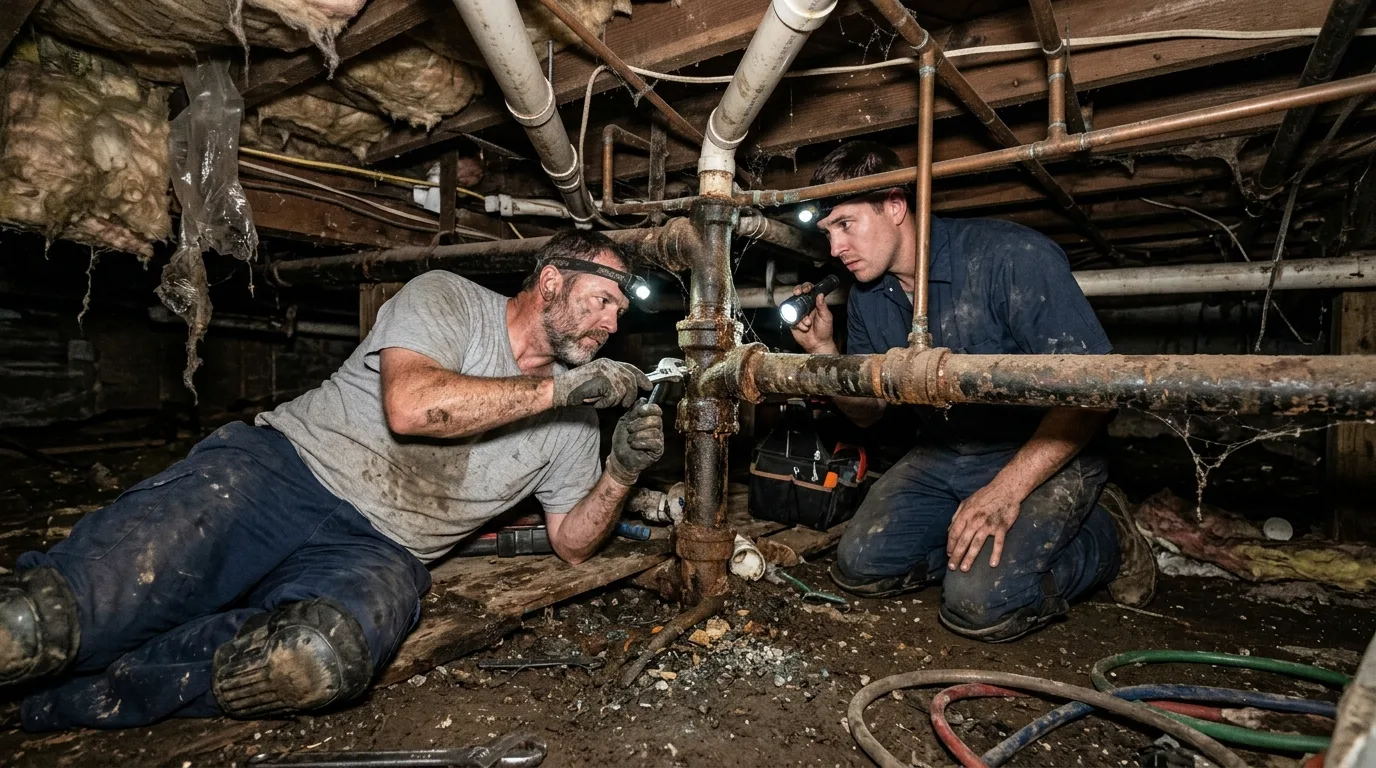
The practical upside is that the older houses here are, in one respect, easier to work on. Raised foundations mean the drain and supply runs are accessible from below rather than buried in concrete. There is no slab to break, no jackhammer, no concrete dust through the living room. The trade-off is that the crawlspaces are tight, often only partly excavated, and frequently full of eighty years of accumulated ductwork, wiring and previous repairs.
If your house has original galvanized supply lines, the useful question is no longer “can this leak be patched?” but “how much of this run is worth keeping?” Galvanized steel corrodes from the inside out, so the section that failed is rarely the worst section, it is just the first one to give up.
Galvanized steel pipe was standard domestic water plumbing until copper took over in the 1950s. It rusts internally, and the rust builds into a rough scale that narrows the bore year after year. Homeowners in this pocket usually notice it as a slow decline rather than an event: the shower that used to be fine now weakens when someone runs the kitchen tap, hot water takes longer to arrive, and the first flow out of a tap in the morning has a brown tinge.
By the time a galvanized line is leaking, the internal diameter of the rest of the run has often halved. Cutting out the failed foot and threading in a replacement restores nothing except the absence of a puddle. This is why repiping conversations come up so often in the Founders’ District, not as an upsell, but because patching a system that is uniformly at the end of its life is money spent twice.
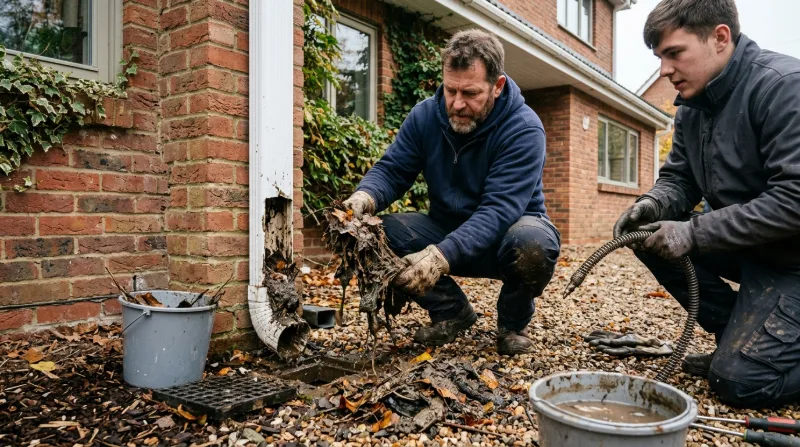
The sewer laterals under these streets are largely vitrified clay, laid in short sections with mortared or gasketed joints. Clay itself lasts remarkably well; the joints do not. Every joint is a seam where fine roots from the mature street trees can find moisture, and once a root is inside the pipe it thickens and turns the joint into a net that catches everything flushed past it.
A camera inspection settles the question in twenty minutes. It shows whether the blockage is a root mass at a single joint, clearable with a cutter head and manageable with periodic maintenance, or whether the line has bellied, cracked or offset, which is a repair conversation rather than a cleaning one. On raised-foundation properties the clean-out is usually accessible outside, which keeps the inspection straightforward.
Opening a wall in a 1920s bungalow is not the same as opening a wall in a 1958 tract house. Lath and plaster does not cut cleanly and does not patch invisibly. Original hardwood floors do not tolerate standing water for long. Cast-iron tubs sit on framing that may not have been designed for the weight of a modern replacement plus a full tank of water.
None of that stops the work; it just means the plumber should be planning access before picking up a saw. Where a wall can be reached from a closet, a garage side or the crawlspace instead of the front room, that is the route worth taking even if it takes longer. Ask about the access plan before work begins, on an older house it matters more than the repair method itself.
 1920soldest housing stock in the city
Most common call on these streets
The call pattern here is genuinely different from the tract neighborhoods. Slab leaks barely feature, because most of these houses do not sit on slab. What replaces them is supply-line corrosion, drainage that was never sized for modern fixture loads, and the accumulated consequences of eighty years of well-meaning previous repairs.
Describe the symptom and the approximate age of the house, that pair usually narrows it fast.
Turn the main off first, then call. On raised-foundation houses the leak is often reachable from below without opening a single finished surface.
Open 24 hours · (714) 386-7076
Streets and landmarks
Roughly the historic core between Beach Boulevard and Stanton Avenue, north of Orangethorpe, taking in the streets around the city’s heritage buildings and Bellis Park.
If your street is not listed, it is almost certainly still covered, the list above is a landmark guide, not a boundary. Give the dispatcher your nearest cross streets.
Requested most in this pocket
Ranked by how often they are asked for at addresses in this part of the city.
Asked by neighbors on this side of town
Not automatically. If the supply is copper installed during a later renovation and only one section has failed, a targeted repair is perfectly reasonable. If the supply is original galvanized steel, a repair fixes the symptom and leaves the cause in place, the rest of the run is corroding at the same rate. The honest way to decide is to cut a short sample out of the failed section and look at the internal bore. If it is half-closed with scale, you have your answer. If it is clean, patch it and move on.
On a raised-foundation house, almost never. That is the significant advantage these older homes have over the tract-era slab houses elsewhere in Buena Park. Supply and drain runs are accessible from the crawlspace, so a plumber goes underneath with a light rather than through your living room with a saw. Where a fixture is directly against an exterior wall, access is sometimes easier from outside. Floors only come up when a run has been buried in a later slab-on-grade addition.
Cutting the roots clears the line but does not remove the reason they got in, which is an open joint in a clay lateral. Three options exist. Keep clearing it on a schedule, which is cheap per visit but never-ending. Spot-repair the specific joint if the camera shows a single point of entry. Or line the run, which seals every joint at once and is the permanent answer where the pipe is otherwise sound. A camera inspection is what tells you which of the three your line justifies.
Often yes, and plumbers generally like them, they are heavy, quiet and effectively indestructible. The plumbing question is the waste and overflow assembly behind it, which on an eighty-year-old installation is usually the actual source of any leak people blame on the tub. That assembly can be replaced without moving the tub in most cases. Refinishing the surface is a separate trade, but the plumbing side rarely argues for removal.
In a galvanized system, because the effective diameter of the pipe is far smaller than its nominal size. A three-quarter-inch line scaled down to three-eighths of an inch of clear bore cannot supply two fixtures at once. It is worth ruling out the simpler causes first, a partly closed main valve, a failing pressure regulator, a clogged aerator, because those are cheap fixes. But in a pre-war house with original supply, corrosion is the usual answer.
Plumbing work continues around them, but nobody should be disturbing either. If a plumber needs to move insulation or ducting that looks like it might contain asbestos, the correct response is to stop and tell you, not to pull it aside and carry on. Old wiring is the same: it is worked around, never leaned on. Say what you know about the house when you call so the plumber arrives expecting it.
For a one or two-bathroom raised-foundation house, typically two to four days, with water off for parts of each day rather than continuously. Raised foundations shorten it because most of the new run goes in from below rather than through walls. What extends it is the finish work, patching plaster properly takes longer than patching drywall, and matching original trim can add a day. Your plumber should give you a day-by-day plan before starting, including when you will and will not have water.
Plumbing repairs inside a house are ordinary permitted work and are not usually affected. Anything that changes the exterior appearance, a new tankless heater on a street-facing wall, a relocated vent stack, an external water heater enclosure, is worth checking with the city before it is installed, particularly on a property with any heritage designation. A good plumber will raise this before ordering equipment rather than after mounting it.
Tell the dispatcher roughly when the house was built. It changes what the plumber brings.
Next door
The neighboring pockets the plumbers we dispatch cover on the same runs through the middle of the city.
Condos and townhomes around Stanton and Orangethorpe with shared stacks and building shut-offs.
Downtown coverage
Post-war tracts above Malvern and Commonwealth, plus the Fullerton-line streets.
North side coverage
Hotels and restaurants along Beach Boulevard where downtime is measured in hours.
Corridor coverage
Mid-century slab tracts, the classic Buena Park copper repipe candidate.
Bellehurst coverageHistoric core dispatch
Pre-war plumbing rewards a plumber who has seen it before. Describe what is happening and you will get a realistic view of whether this is a repair or the start of a bigger conversation.
(714) 386-7076 · Answered 24 hours a day